



















Choosing a dog may be the only
chance you have to pick a relative.
We are always happy to answer any questions you may regarding white West Highland Terrier puppies, and for your convenience, we have posted the most frequently asked questions we have been asked throughout our years of breeding. These are questions you need answered prior to the decision to purchase a Westie or before the arrival of your new puppy.
Each puppy adoption is unique, so if you do not find the answer to your specific question, please feel free to call 252-478-4356 or email us at ashley@arrowheadacreswesties.com. We will answer each question to the best of our ability.
We will also be available to give advice and support for the life of your puppy.
Q: What is the difference in limited and unlimited registration?
A: If your puppy is purchased from Arrowhead Acres on a limited AKC registration he/she is NOT eligible to register offspring with AKC. It will also NOT be able to participate in any AKC sponsored conformation events.
If your puppy is purchased from Arrowhead Acres on an unlimited AKC registration he/she IS eligible to register offspring with AKC. The puppy IS also eligible to compete in any AKC sponsored conformation events.
Basically, for a person or family wanting a beautiful, healthy, fun, companion the limited AKC registration is what you need. If you are interested in conformation, showing, or breeding you will need an unlimited AKC registration.
We reserve the right to make the final decision rather to sale our babies on limited or unlimited AKC registration.
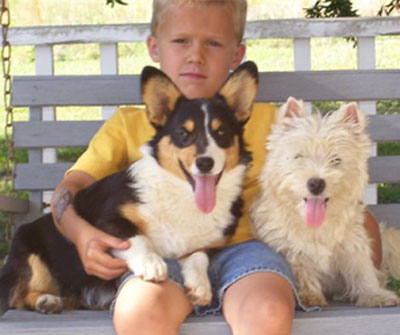
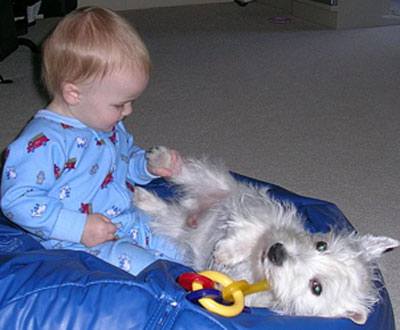
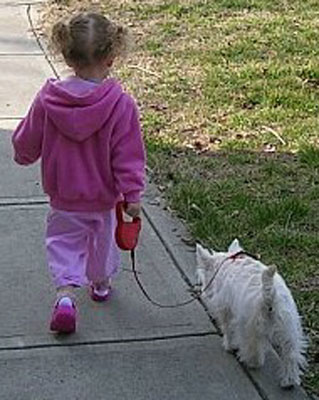
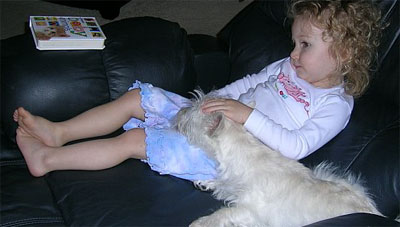
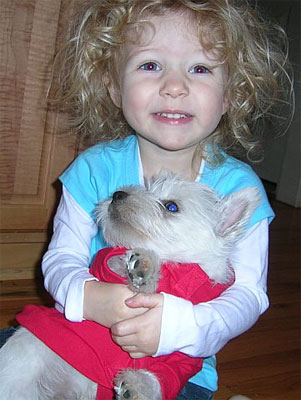
Q: Are Westies good with children?
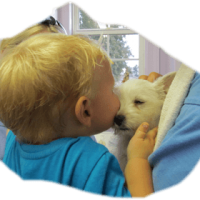
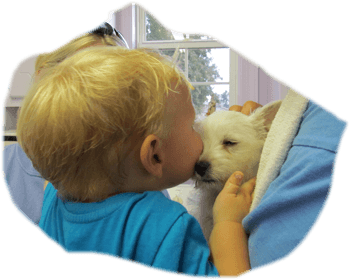
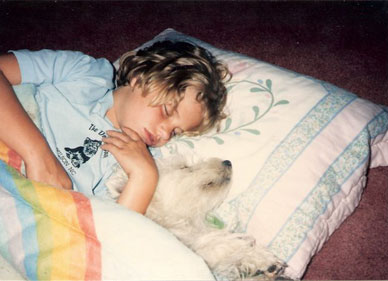
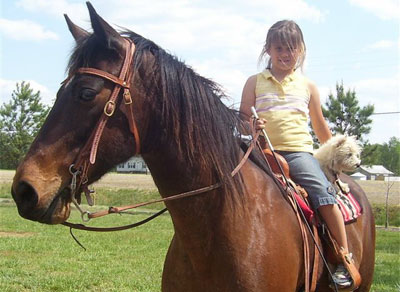
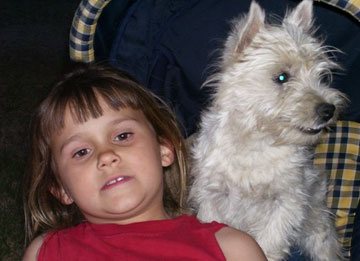
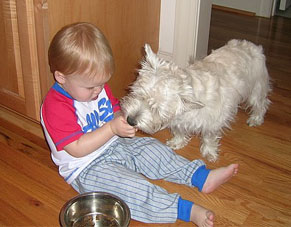
A: A Westie can be your child’s best friend. Westies are a hardy, confident breed and can physically handle a certain amount of horseplay. They love to chase a ball and play tug of war. They can also play the role of a baby doll. They will make an excellent bed partner for your child, if this is acceptable in your home.
It will take a certain amount of discipline, training and supervision for the child and the puppy in the beginning. Never leave a child under five years old alone with a young puppy. If you plan on having children in the lifetime of your puppy you will need to acquaint your puppy with children while he/she is under one year old. The puppy will need to spend ample time socializing with children to be receptive and enjoy a new member of his/her family later in its life. A Westie that is mature and NEVER been around small children may not think kindly of a new creature in his space. But even a grown, mature Westie that has been taught his role and some manners will at least tolerate a new addition to the family.
Over the years we have heard many, many happy stories of a child and their Westie being inseparable. If any issues of discipline or any problems arise please, please call or email us.
Q: Do Westies have genetic or congenital defects that are common to the breed? If so have any of these defects made themselves present in your bloodlines?
A: Genetic or congenital defects are relatively few in Westies. The Westie has been left for the most part in its natural, original state. Up to this point there has not been a lot of indiscriminate breeding nor has man made any demands for big changes in their conformation or coats. Only the white coat color was used in the development of the Westie and it is the result of a dominant gene.
There are only four or five serious or possibly lethal, genetic defects that can be found on occasion in a Westie and in our almost seventeen years of breeding not one has presented itself in our bloodlines. We have had only five or six puppies over the years that have gone to their new homes and a congenital problem has arisen. At these times we have run all test and exhausted all possibilities of the defect being genetic. We offer a very extensive guarantee to cover any congenital or genetic problems should they arise.
Q: Do you recommend the use of a crate for house training? If so what size and type?
A: We strongly recommend the use of a crate for house training. The crate is also a great tool to protect your puppy and your home.
We recommend the airline approved plastic crates. This type crate will make your puppy feel more secure and he /she will be free from drafts more than in a wire cage. The size of the crate is very important. A dog will not soil where he has to lie down if at all possible. It needs to be just large enough for an adult Westie to stand up and turn around in comfortably. The approximate measurements should be 17”wide by 25”deep by 16” tall.
Q: Is there a history of skin allergies in your Westies? If my Westie does develop allergies do you have any advice?
Q: Are Westies hypoallergenic or do they shed?
A: The AMA reports the Westies have relatively low dander and shed almost none (ranked # 7) and in most cases is acceptable for individuals with asthma or allergies.
Q: Do you have champions in your bloodlines?
A: We have been breeding Westies for over twenty-five years and in the beginning there was a reasonable amount of champions in the bloodlines. After twenty-five years all the champions are off of the pedigrees. But we have dogs that could more than qualify for the show ring and we have placed several puppies over the years in successful show homes. We feel we do not have to have dogs with the title of champion to raise champions. Our main goal is to raise healthy, happy and good-tempered companions.
Q: Do you show your Westies?
A: In our years of successfully showing horses we have found that any type of conformation showing is very political. Showing is not always about the horse, or the dog in this case, but who is at the end of the lead so we have never had the desire to show our dogs. We have sold several puppies to show homes over the years.
Q: What kind of food do you feed? If the kind of food you feed is not available to me what do you recommend?
A: Our puppies are on 4Health – Salmon and Potato from the time they are three weeks old. You will be sent home with enough of this food to last four or five days. If you are unable to find this food we recommend Purina Pro Plan Sport or Ukanuba puppy food.
Q: Do Westies make a good lap dog?
A: For some Westies in your lap will be their favorite spot. While other Westies want to be close to you but not necessarily always in your lap. These loving traits along with the confident traits of your beloved companion allow them to be an ever present member of your family while also being content with your absence during your busy days.
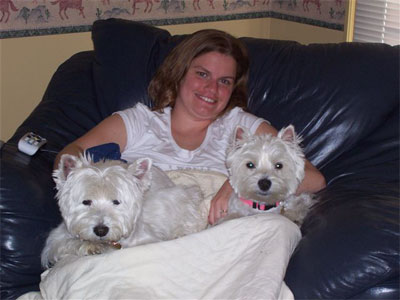
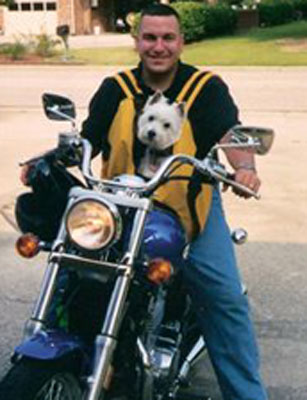
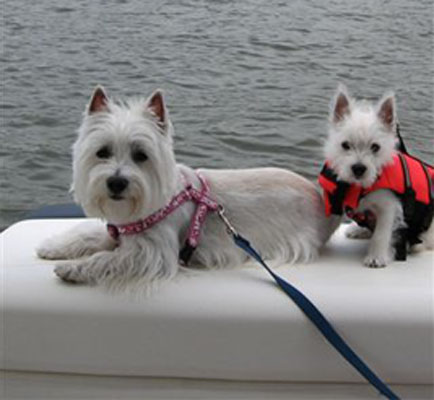
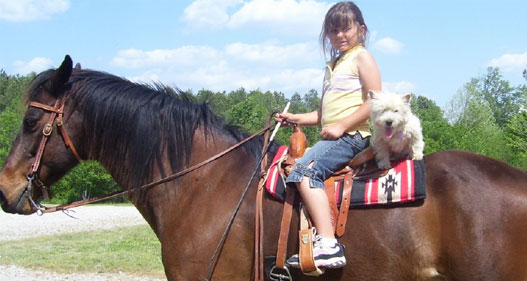
Q: Do Westies like to travel, hike, swim, ride on boats, ride on a bike or motorcycle?
A: Westies like to share in your activities. They are confident and hardy and if introduced to any activity correctly and safely they are sure to enjoy it as long as it is shared with you.

Q: What age should a puppy be when it goes to its new home?
A: Breeders and vets differ in their opinion as to what is the best age for a puppy to go home to its new family.
When we started breeding Westies in 1992 it was typical to send puppies home at six weeks. We have had great success with our babies leaving at six weeks. Though today, most of our puppies go to their families at eight weeks. Over the years as breeders and vets learned more about the psychological aspect of a puppy some breeders went to eight weeks. My mom bred Maltase for fifteen years. Because the Maltese were a fragile breed and so small, she kept her babies until eight weeks and sometimes ten or twelve weeks if they were extra tiny. Westies are a very stout, hardy breed. Our babies here at Arrowhead Acres have dry kibble available to them at three weeks of age so at six weeks they are eating well and for the most part going outside to potty.
There are advantages and disadvantages to taking a puppy home at eight weeks. Two of the advantages to the eight-week age are bonding and dominance. In our opinion, eight weeks is a terrific bonding period. At this age you can also establish a dominance role easily. Instead of finding his position in “a pack of dogs” he will find a place in your family. The advantage to eight weeks is the transition does seem a little easier on the puppy and there seems to be less crying and separation anxiety. However, all of our puppies are well socialized. If they remain here with us at Arrowhead Acres until they are ten or twelve weeks the transition into your home will still be successful.
We do not leave the pups with their mamas over six weeks because most of our mamas are thirteen to seventeen lbs. and a six-week-old litter of four or five puppies is just to hard on them. Some Westie moms can become a little rough when teaching their babies their place and perhaps even hurt the babies when left to wean the puppies on their own.
As a new puppy owner you need to make the decision you are comfortable with and if you need help in making that decision we will be glad to discuss it with you. We do require that all puppies be paid for in full by six weeks.
Q: Do you sale your puppies to pet stores?
A: Absolutely not!!!
Q: Do Westies have eye stains?
A: Puppies will sometime have eye stains but these will disappear with time as the puppy matures. Westies and Samoyeds are two white breeds that do not have eye stains. The reason for this is because they have a dominant white gene. Most other white breeds have a recessive white gene.
Q: Do you remove dewclaws on your puppies?
A: No we do not. There is no medical reason to do this and it is not even required for showing Westies as it is in other breeds.
Q: Why do some Westies have brown or rusty looking stains on their feet and mouth?
A: We agree with Ruth Faherty in the book Westies From Head To Tail, that a lot of this staining comes from chemicals in the water. Each Westie’s coat reacts differently to these chemicals; therefore some are whiter than others. In her book Ruth Faherty suggest a water filter if you feel this is the cause of your Westies staining. An excessive amount of sun can also cause a brown or burnt look to the coat. The beard and feet of an indoor house pet will stay basically white and clean with minimal care. The absolutely snow-white coats you see in the show ring or books are chalked. This is a grooming procedure known mostly to show people.
Q: Do any of your Westies have the beige or yellow looking dorsal stripe down the center of the back?
A: Some of them do and some do not. This is a perfectly acceptable trait even in the show ring. At first glance you would not even notice this. The light discolored stripe could be there for two reasons. The first reason could be because in the grooming process too much live coat has been removed. The second and more likely reason is a matter of genetic background going back to the origin of the Westie many years ago, the Carin Terrier.
Q: Why do some Westies ears look bigger and faces appear longer and narrower than others?
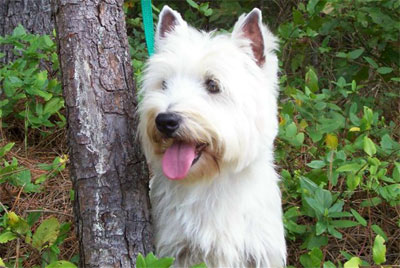
A: The most obvious answer is because some ears are bigger, and faces longer and narrower. The more likely reason has to do with the grooming or coat condition on a specific dog. Do not get me wrong there are some indiscriminate breeders who have huge ears and long narrow faces on there Westies but for the most part a Westie that was bred nicely and appears to have large ears and long face is due in a big part to improper grooming or coat condition.
BELOW YOU WILL SEE AN EXAMPLE OF THE GROOMING OR CONDITION OF A COAT MAKING AN ENTIRELY DIFFERENT APPEARANCE OF THE FACE AND EARS. EACH OF THESE PICTURES IS THE SAME DOG.